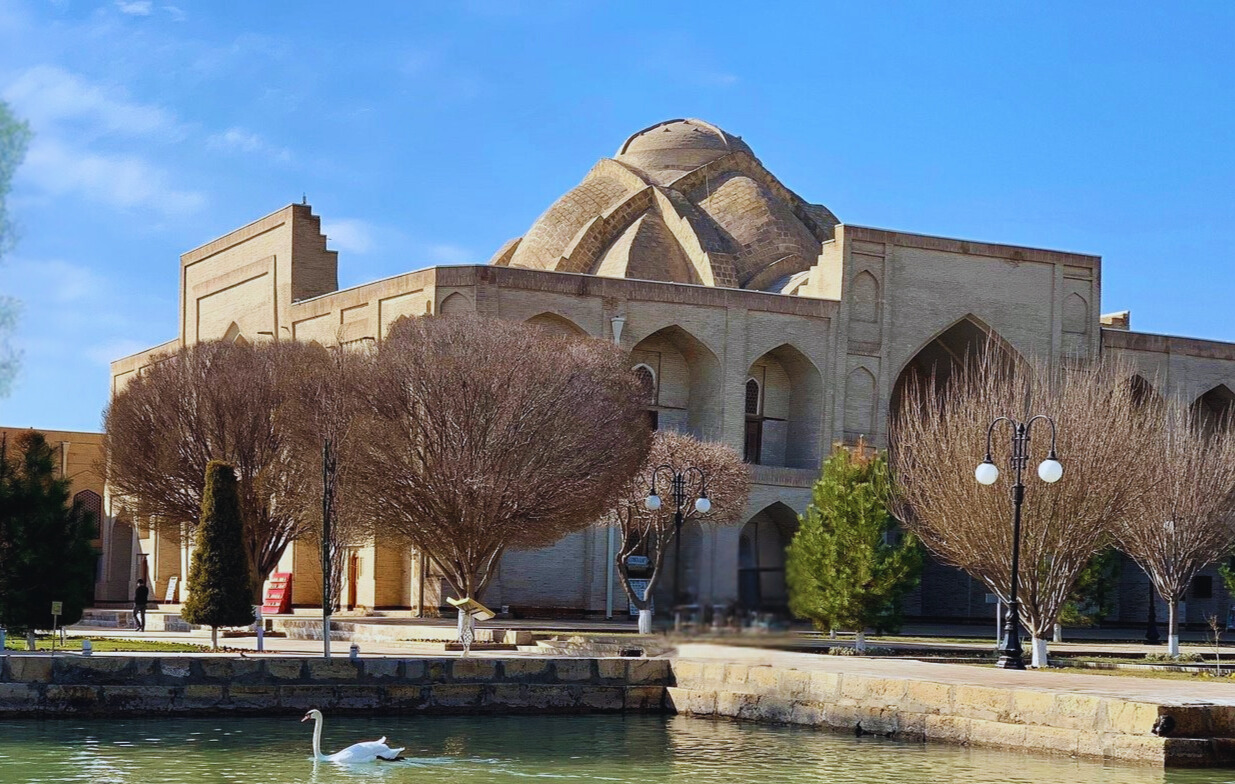
Bukhara-i-Sharif is a land that has become a cradle for great people. In this country, which is one of the hotbeds of world civilization, for centuries great intellectuals were born and created, leaving an indelible mark on history.
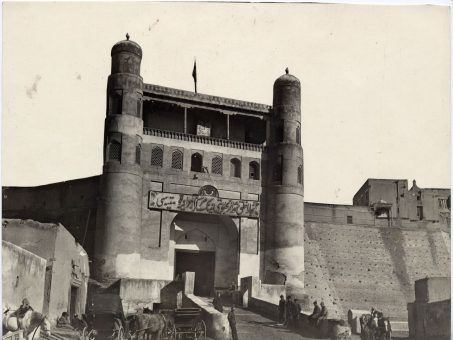
Each historical monument of Bukhara testifies to the great intelligence and potential of our people, their knowledge and enlightenment, their spirituality and culture, their philosophy and religious development. Unfortunately, in the terrible years of our history – the tyranny of Tsarist Russia, the political repressions of the Soviet era, in addition to the persecution of religious leaders, religious institutions and historical monuments also began to be destroyed. Thousands of mosques and madrasas, magnificent palaces, palaces, historical monuments, which were unique examples of our national architecture, were demolished and turned into granaries, donkey sheds, cotton drying areas…
During the colonial period, the rulers who lost their freedom lost their attention to cultural heritage and national traditions, and preventing this became an urgent task for local intellectuals and educators. Mahmudkhoja Behbudi, who studied in the Bukhara madrasas, could not remain indifferent to the terrible state of Bukhara Sharif at the beginning of the last century. Behbudi finds the right solution to the question of how to respond to the neglect of holy places and historical monuments and the indifference of local rulers and scholars to this.
According to the memoirs of S. Aini, Mahmudkhoja Behbudi traveled to Bukhara on October 14-20, 1912, to visit the mausoleum of Bahauddin Naqshband. After seeing the condition of the shrine and the mosques and madrasas there, he decided to write a new article of his own. The article is presented as a letter written on behalf of Amir Doniyalbiy (1758-1785), the founder of the Mangid dynasty of Bukhara. We bring to your attention this letter, which we have translated…
AMIR DANIYOL’S LETTER FROM THE GRAVE
I, the great ancestor of the Bukhara emirs and the founder of the Mangid dynasty, am the king of the great Bukhara and Turkestan lands. Through hard work and politics, and through the zeal and devotion of my army, I made the corrupt khans and countless Uzbek beks in the Turkestan region swear allegiance to me, that is, I subjugated them, and I established the Bukhara Emirate. Thus, the flag-bearing beks and ambassadors of Turkestan became available to me. The Uzbeks of Great Turkestan and all the peoples and Turkic tribes gave them the high title of «Daniyol Otalyk».
One of my methods was to listen to all the beys in important matters and finally make a decision based on my own opinion. Even my beloved wife, Oyim, would strongly object to me, saying, «Why do you say that everyone’s word is acceptable in national affairs, bey?» I would say to her, «O, mother of Shah Murad, your word is also acceptable!» This phrase is used these days among the people of Turkestan as a proverb.
Let me give you an example from my life: my beloved son (my wife, Aym) used to visit me during Eid and Arafah: “During Eids, the children of the people bloom like flowers, dress up, and are decorated, but my Shahmurad is in old clothes!” – she would lament. I, on the other hand, would receive a salary from the treasury according to my duties and please my son. Sometimes, if the treasurer of the treasury did not accept my request, I would become angry… The past is past! The good-natured, my guardian, my beloved son Shahmurad, who received my upbringing, added new lands to my country, and subjugated Merv and other lands to my country.
And Kandi1 was not kept in Bethlehem, that is, because of his great wealth, he did not take money from the treasury at all. In the summer, he wore the surface of the fur, and in the winter, he wore the surface and the inner warm part. And he was a madrasa student, a scientist and a nutritionist. He was called «Amiri Chetmakon» because of his Taba’a, i.e., a lot of repentance and forgiveness, and his love of solitude. The blessed huts (tombs, tombs) left by Grandfather Temur, Allama Ulug’bek, Yalangtosh Bahadir, Shaibani Khan and other greats inherited mosques, madrassas and mausoleums, and even savma’s, i.e. (temple of non-believers), cleaned and repaired the Koktash throne left by the great Timur in Samarkand.
Once upon a time, the capital of Amir Temur, the city of Samarkand, which had become deserted due to internal strife, was a city full of ants and birds, with nothing but old buildings. Shah Murad filled 155 neighborhoods of Samarkand with immigrants. At that time, the madrasas of Samarkand were as poor and dilapidated as this dahma of mine. He swept and cleaned the kand alila, that is, he swept and cleaned (everywhere) with his generous hand. He also built the «Shosh Sukba» in the middle of the city… Oh, wow! I have no strength to write all this, and I have no need for it. I am a person of the afterlife, I have no more contact with the mortal world… In short, the enlightened one, the current emir of Bukhara, Sayyid Alim Khan, is my seventh generation.
I have been living in the poor dahmam that I built near the mausoleums of Khoja Bakhauddin since 1199 (1785). No matter how my heirs manage the country that I have left behind, the emirate, I have no business. I only ask and beg the government of Bukhara, which is the «Water of Patterns»; if the government does not listen, then the patriotic scholars of Bukhara today; if they do not listen, I ask and beg the people of Sharia to place students of knowledge and reciters instead of the lepers, lepers, paralyzed and blind who live in the holy madrasah and qarikhan near my dahma. Unfortunately, the mosque and rooms here have become the abode of lepers and lepers.
20-30 rooms in the madrasah were (originally) built for students of knowledge. Today, the endowment of each room is more than 100 sums. There are also enough endowments for imams, muezzins, mudarris and workers, who, despite receiving their salaries on time, do not fulfill their duties. The imams and mudarris responsible for this always live in Bukhara and never come here. The rich buy the houses I built for 300 sums and sell them for 600 sums in order to profit from the endowment. How did the qadi and muftis of Bukhara (who allowed the bay’ and shara’) implement this false fatwa into the Sharia? Oh, if I were alive, I would put the «gul bazaar beg» (special iron chain) of my time around their necks. But to whom should I speak? My present-day turbadors, i.e. interlocutors, are Roman lepers. Since the Bukhara people do not see this, I am helpless and forced to cry out in the zarida (magazine) and the press. The mosque and the dahma on the way to the pilgrimage to Khoja Bakhauddin are mine. Let the pilgrims and travelers see them, learn from them, and learn from the indifference of the people of Bukhara. With a lasting prayer and greeting:
Founder of Bukhara Emirate: Amir Daniyalbi.
1 «Candi» is derived from the Arabic word «qand», which means wealth. Baitul «mol» means property (treasure).
On this date, October 14-20, 1912, I traveled to Bukhara. Bukhara is an old city. Old tools and old customs are the subject, that is, the best. Every traveler, according to his nature, seeks out old things. I also searched for old news and documents. During my visits to the tombs of Hazrat Bahauddin and Amir Daniyal, I came across some things. One of them is this letter from the late Daniyalbiy Otaliq. I sent a copy of this letter to the office with the intention of presenting it to the subscribers of the prestigious «Shura» magazine. In the future, other documents will also be published as a message, that is, a brochure.
From the muftis of the Samarkand (Darulkaza amonlik, goodness) Kazikhana:
Mahmudhoja Behbudi
«Shuro» magazine. 1912. No. 23
The objections in the letter written on behalf of Amir Daniyalbiy were actually painful points in the heart of Mahmudkhodja Behbudi. He saw the use of the power of the press as the only way to express his opinion and shape public opinion. The last emir of Bukhara (Sayyid Alimkhan) also remained indifferent to the sounds coming from the grave of his great-grandfather. Even during the Soviet era, Behbudi’s dreams remained dreams…
Independence has literally returned our national identity to us. During this period, the names of our enlightened-jadid ancestors are being vindicated, their scientific heritage is being widely studied, and their lives, works, and works are being promoted.
Presidential Resolution No. PQ-462 (27.12.2024) “On the wide celebration of the 150th anniversary of the birth of the founder of the Turkestan Jadid movement, a prominent writer and public figure, publisher and teacher Mahmudkhodja Behbudi” was adopted. Based on this, a program of measures to be implemented in 2025 was approved. The resolution sets urgent tasks such as studying the scientific heritage of Mahmudkhodja Behbudi and conveying it to young people in an understandable language. The above-mentioned symbolic letter from Doniyolbiy also informs our young people about the personality of Mahmudkhodja Behbudi, his goals and dreams.
Today, we can safely say that the dreams of our ancestors are being realized in our New Uzbekistan. Today, the Bahauddin Naqshbandi complex, as well as the pure spirit of Mahmudkhodja Behbudi, who wanders around the Doniyalbiy mausoleum, are a witness to the extent to which our New Uzbekistan has become beautiful, and that the Bahauddin Naqshbandi complex has become so beautiful, like the legendary swan emerging from the fire, and has come to the world.
Author: professor A. H. Khamraev